



Research in front of the curtain
We present our current research projects.

SFB Language between redundancy and deficiency
Significant progress has been made in the field of artificial intelligence in recent years, which has also been widely discussed in public. ChatGPT, for example, appears to use language very similarly to humans. In view of these developments, the question arises as to what distinguishes humans from machines in the field of cognition. The traditional definition of humans as 'talking animals' goes back to Aristotle: it is our ability to speak that distinguishes us from all other beings and enables us to develop complex social, cultural and political structures. But in the age of talking machines, we have to ask ourselves whether language can still be considered a unique characteristic of humans. One possible answer is that the way the latest generation of AI handles language is actually similar to human language processing: both are stochastic systems. The difference between them could merely be in the strength of the connection to other cognitive areas such as perception or the motor system-an area in which humans have a clear advantage over AI.
The SFB "Language between Redundancy and Deficiency" pursues a different perspective, which is supported by a wealth of results from formal grammatical language research: Language is at its core a symbolic rule-based system that is unique to human cognition and similar to logic as well as mathematics. Syntax, the core of grammar, is a purely symbolic system, which makes human language fundamentally different from the "language" of AI. However, human language ability is interwoven with a probabilistic cognitive system - a system that is guided more by experience and probability patterns than by fixed rules. This increases its adaptability to cognitive, social, cultural and political contexts. The embedding of language in the general cognitive system can be modeled theoretically by flexible rules that allow linguistic operations to function in situations that deviate from their precise definitions, either by a lack of information (deficiency) or by an excess (redundancy).
Building on the important tradition of formal linguistics in Austria, the SFB brings together experts from the Universities of Graz, Vienna and Salzburg who work closely together to investigate how the linguistic system is adapted to its cognitive environment. The focus is on two core phenomena of the context-dependent use of language, namely pronouns and ellipsis. Pronouns enable the reuse of already introduced meanings without explicit syntactic encoding, while ellipsis enables the reuse of linguistic forms - such as sounds, characters or gestures - without actual articulation. In investigating these phenomena, the SFB uses current methods of empirical linguistics, such as psycholinguistic experiments or corpus studies, but also mathematical formalisms. The theory of language between redundancy and deficiency to be developed within the framework of the SFB, in which symbolic and probabilistic systems are harmonized, has the potential to open up groundbreaking perspectives for the cognitive sciences.
Duration: 01.03.2024-29.02.2028
Project management: Univ.-Prof. Dr. phil. Edgar Onea
E-mail: edgar.onea-gaspar(at)uni-graz.at
Phone: +43 316 380-2633
Funding body: FWF
You will soon find more information about the project on the project website.
Author libraries as spaces of knowledge: Digital cataloguing of the Arnim Library catalogue
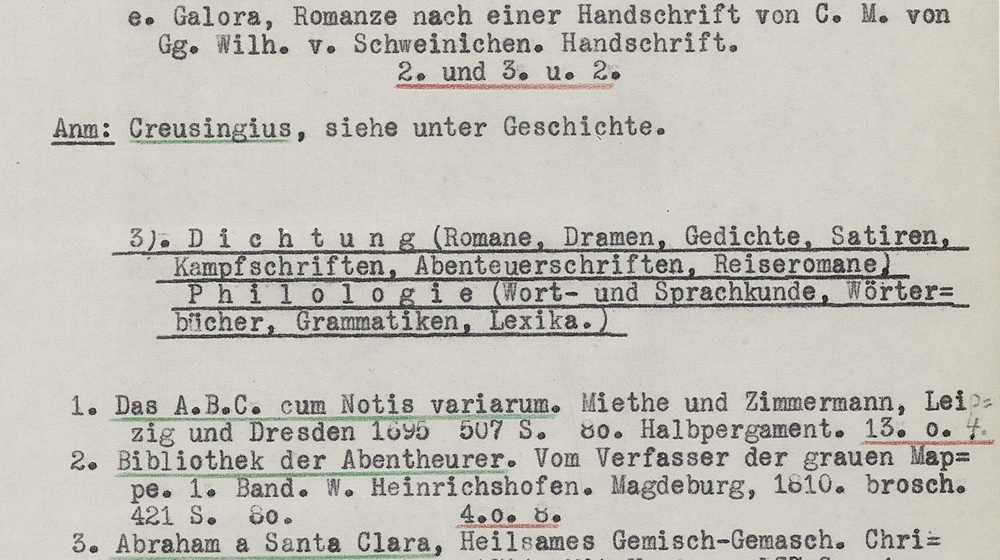
How do writers organise their knowledge? A new collaborative project between the Institute of German Studies and the Institute of Digital Humanities at the University of Graz is making the previously unpublished catalogue of the private library of Ludwig Achim and Bettina von Arnim (1929; supplemented by hand in 1934) available for academic research. The catalogue lists around 4,000 titles and simultaneously documents the original shelving arrangement at Wiepersdorf Castle (Brandenburg) – a rare window into historical knowledge architectures and reading practices.
The team is transcribing and structuring the catalogue preserved in the Duchess Anna Amalia Library in Weimar and processing the data so that it can be searched in a targeted manner. This opens up new research questions: Which neighbouring bookshelves can be identified as thematic clusters, phases of work or family networks? To what extent does the placement correlate with documented reading habits and intertextual references? Where do shelf arrangements and catalogue arrangements diverge, and what do such discrepancies reveal about practices of collecting, organising, reading and writing?
The results will be made available as open research data under a CC-BY licence in accordance with FAIR principles.
Duration: October 2025 to June 2026
Project leaders
: Dr Anke Jaspers (Institute of German Studies), contact: anke.jaspers(at)uni-graz.at;
Prof. Georg Vogeler (Institute for Digital Humanities), contact: georg.vogeler(at)uni-graz.at
Team
: Stefanie Holanik, BA, MA
Funding body: CLARIAH-AT
With the kind support of the Duchess Anna Amalia Library.
Vienna and Graz - cities and their influential force
The FWF-funded CRC "German in Austria (Deutsch in Österreich - DiÖ). Variation - Contact - Perception" is a joint humanities project in which, for the first time, five institutes throughout Austria are jointly involved in researching and documenting German in Austria ("DiÖ"). Graz forms the sub-project 04, "Vienna and Graz: Cities and their Influencial Force".
The focus of PP04 is on language use in the cities of Vienna and Graz as well as in the surrounding communities. Using systematic quantitative and qualitative analyses, data from speakers of different age groups will be examined in order to gain an insight into the complexity of language in urban areas and at the same time to gain indications of a possible linguistic influence on agglomeration areas. Recordings of speakers in different speaking situations will be used as the data basis for the intended grammatical and phonetic/phonological analyses. Among other things, the following variationist and sociolinguistic questions will be answered: How is language use constituted in the city and what differences can be identified between Vienna and Graz and the respective surrounding communities? What correlations with non-linguistic factors can be determined? To what extent do different speech situations and contexts affect the individual choice of variants in urban centers? Can an urban influence on surrounding communities also be proven linguistically or is it even the other way around?

Duration: 01.2016-06.2025
Project management: Univ.-Prof. Dr. phil. Arne Ziegler
E-mail: arne.ziegler(at)uni-graz.at
Phone: +43 316 380-8165
Project staff: Nina Bercko, BA MA, Mag.a phil. Stefanie Edler, Bakk. phil., Ann Kathrin Fischer, BA BA MA, Kristina Herbert, BA MA, Nina Kleczkowski, BA MA, Teresa Monsberger, BA BA MA, Georg Oberdorfer, Bakk. phil. MA, Dragana Rakočević, MA, Gerrit Silvia Tscheru, BA BA MA, Maria Voit, BA
Student assistants:Lisa Handler, BA, Lisa Höllebauer, Elena Koreschnig, BA, David Samitsch, Veronika Schiefer, Lena Stückler, BA
Funded by: FWF
Further information on the project can be found on the project website.